Give a tired bee
a second chance.
A compact field rescue kit for grounded, exhausted pollinators — a calm, shaded chamber to settle them, sugar bee-water, and gentle tools, in a shell designed to be moulded from recycled ocean-bound plastic.
It's still a concept — the launch list gets the launch-day link and the best early prices first.
Wild pollinators are in trouble. Lifting one off the pavement is something you can do today.
Pollinators quietly power the food on our plates — and wild bees, hoverflies and butterflies are in steep decline from habitat loss, pesticides and heat. Many grounded bees are simply out of fuel; for them, a few calm minutes and a few drops are often enough. And little beats the moment she lifts off. Every rescue feeds a bigger fix: a share of every pledge funds the long game — wildflower forage and habitat for wild pollinators first, and support for the beekeepers who raise healthy colonies. For wild bees, forage like that is the lifeline that matters most.
of the world's leading food crops depend at least in part on pollinators (IPBES, 2016)
of wild flowering plant species depend at least in part on animal pollination (IPBES, 2016)
annual market value of the crops that depend on pollinators (IPBES, 2016)
is how long most bees that are going to recover take, once they're shaded with a drink
One bee at a time still adds up.
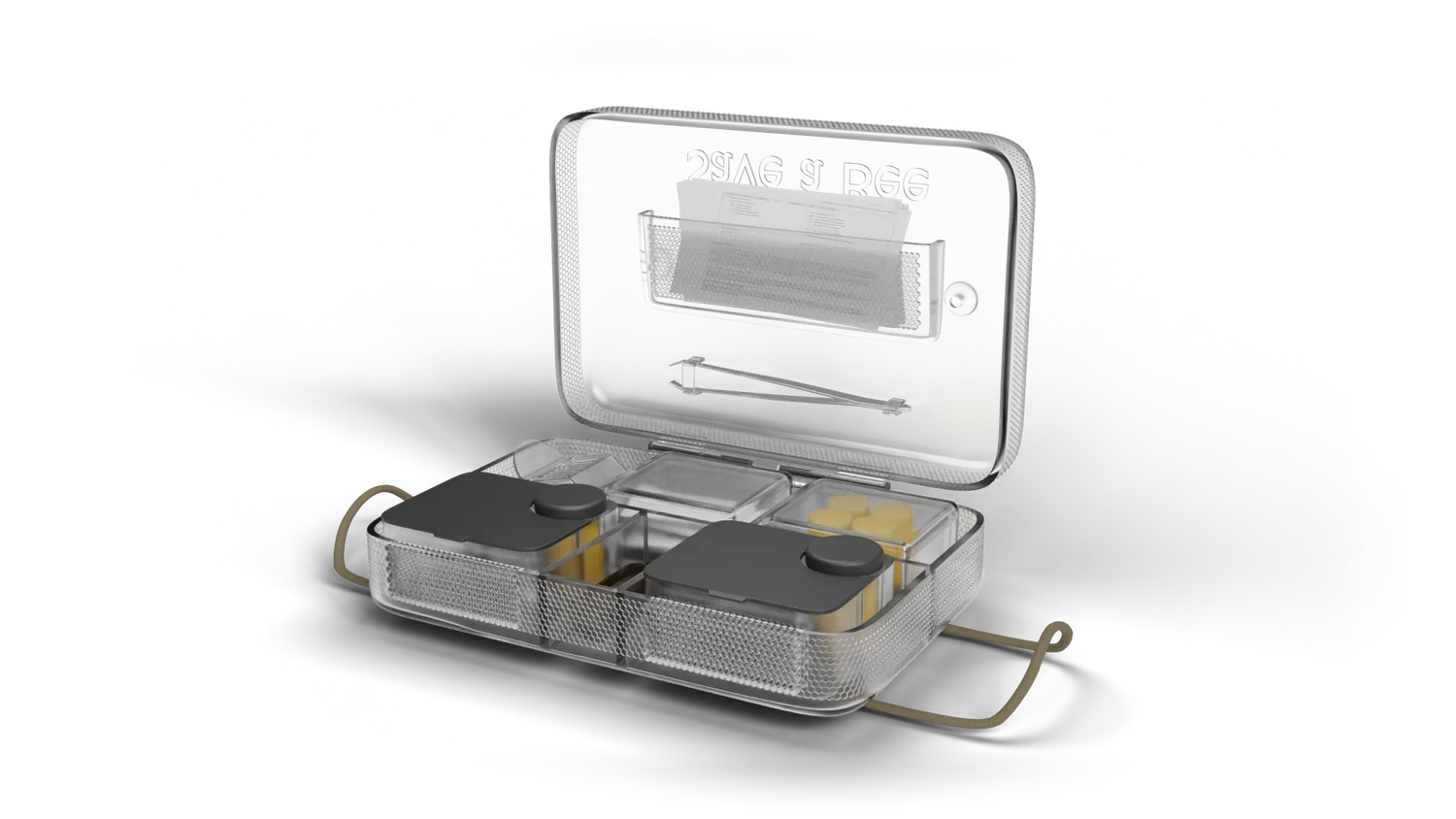
Everything you need to revive a bee, in one frosted shell.
Each tool does one job — shelter, shade, hydrate, catch gently, release. No clutter, and nothing that grips, pins or traps her.
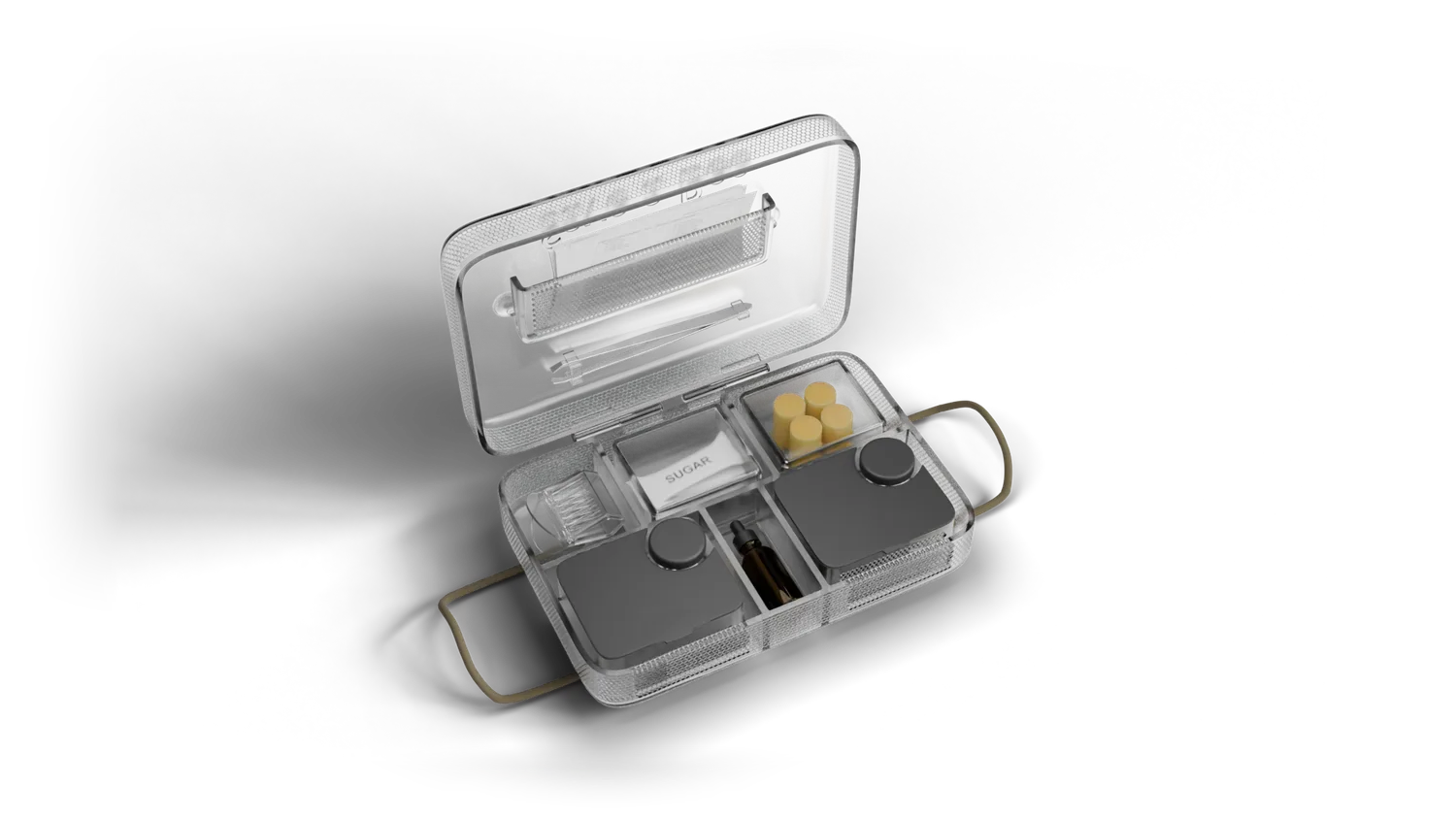
Concept render — no kit has been manufactured yet
Two bee pods
Clear-walled chambers with a honeycomb floor and a dark, opaque top: shade and quiet are what settle a rattled bee, while fine vents on the front, top and bottom keep air moving. Nothing in the kit makes heat, and it isn't meant to — keep the pod out of direct sun and never in a parked car. The pods sit on opposite sides of the kit, each under its own dark cover, so two rescues never share a chamber — and never carry two bees from different places in the same kit. Each pod has a sealed, capped drinking well: fit one of the four sponges and she laps from damp foam instead of standing liquid. The well is closed off from her chamber and she drinks through a 3 mm port, so a honeybee or a bumblebee can't get into the water. One honest limit: some solitary bees are only 4–5 mm long and could pass a port that size. For a bee that small, use a flower or a leaf, not this kit.
Sugar + dropper bottle
An amber-glass dropper bottle — it will ship empty — plus three pre-measured white-sugar sachets. If she doesn't fly off after a moment's watch, she's out of fuel and it's time to help: fill to the line with cool or lukewarm water (never hot), drop in one sachet and shake into a 1:1 white-sugar bee-water, then add 4–5 drops onto the pod's sponge — moist, not dripping, and never poured onto the bee herself. Mix it fresh: bee-water keeps about a day in a warm bag, so tip out what's left and rinse the bottle after a rescue rather than carrying old syrup around. Sugar water is a rescue, never a diet — and never a feeding station left out in the open. Mix it fresh: bee-water keeps about a day in a warm bag, so tip out what's left and rinse the bottle after a rescue rather than carrying old syrup around. Sugar water is a rescue, never a diet — and never a feeding station left out in the open. Mix it fresh: bee-water keeps about a day in a warm bag, so tip out what's left and rinse the bottle after a rescue rather than carrying old syrup around. Sugar water is a rescue, never a diet — and never a feeding station left out in the open.
Bee catcher
A clear plunger cage — centre it over a tired bee and scoop gently, so she slides inside with room at the floor for her legs. It never closes fully: a moulded travel-stop leaves a roomy 30 mm chamber, so she's contained but free to move, never clamped, and the bars stop short of the floor so her feet can't be caught. It's sized for the whole range you'll meet on the ground — from a honeybee up to a big buff-tailed bumblebee. The one bee it's not for is a spring bumblebee queen: she'd fit, but a queen in early spring is a whole colony waiting to happen, so leave her be and move her gently on a leaf instead.
Tweezers & guide
Stainless tweezers fit and retrieve a pod's well sponge and clear debris — the well is sealed off from the bee, so they never go near it. Plus a printed rescue guide tucked in the lid.
The whole rescue, in a little over two minutes.
From a bee grounded on the pavement to back in the air — what's in the kit, how a rescue works, and why a share of every pledge funds beekeepers and wildflower forage for every pollinator. Tap the speaker for sound.
Music: "Wholesome" Kevin MacLeod (incompetech.com) — Licensed under Creative Commons: By Attribution 4.0 License, https://creativecommons.org/licenses/by/4.0/ · Edited: trimmed and mixed under the narration.
A rescue in five calm steps.
No experience needed. Watch her for a moment; if she doesn't fly off, she's out of fuel. Ease her into a pod, keep her shaded and still, and put 4–5 drops of bee-water onto the pod's well sponge — never onto her. Then take the pod back to where you found her, ideally near flowers, lift the cover, and let her fly. One exception, and it's the important one: a big, slow bumblebee in early spring — or one found indoors in autumn or winter — is very likely a queen. Don't warm her and don't keep her.
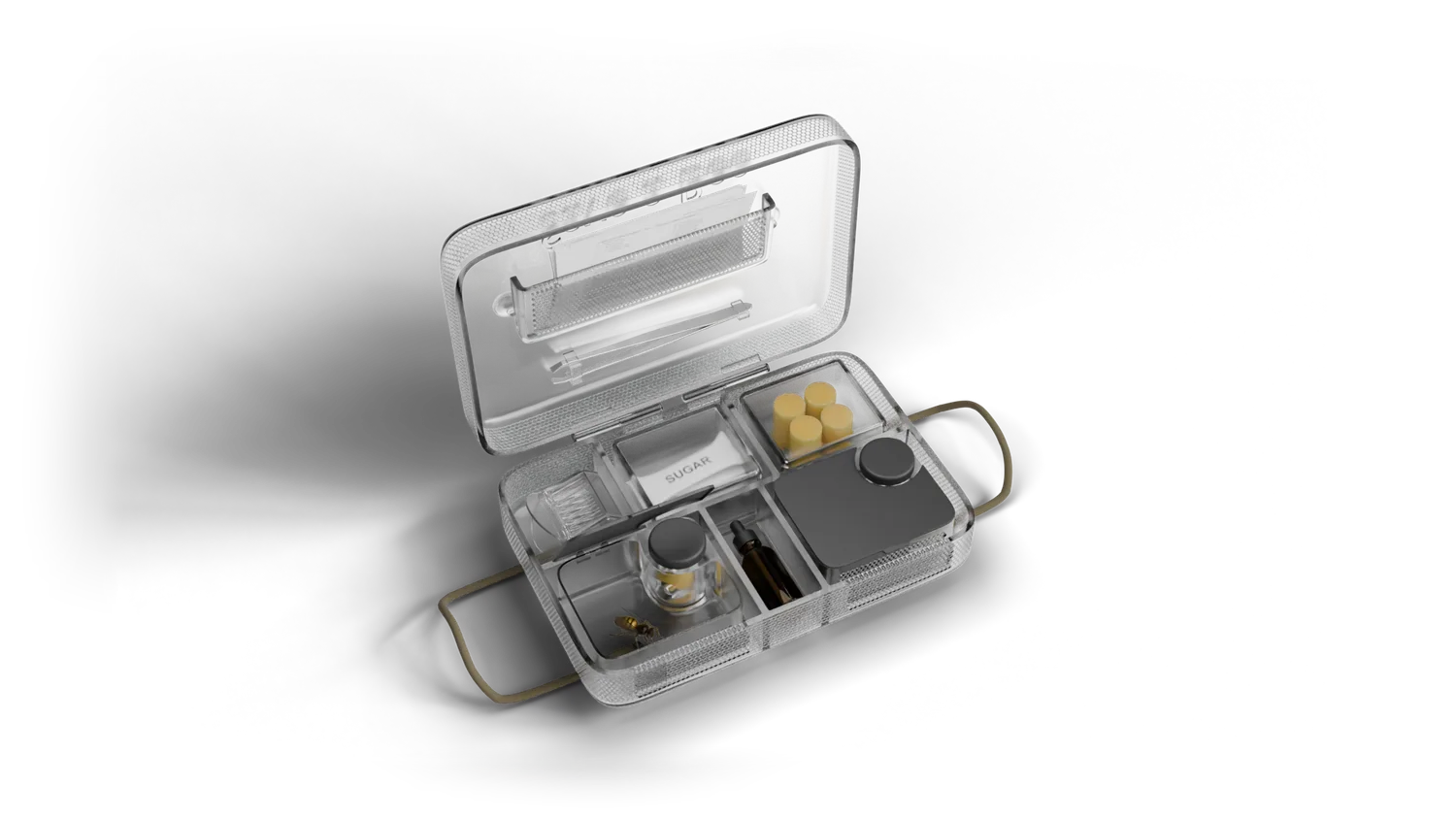
Her recovery room — a bee resting inside the pod (concept render)
Check, then watch
First, make sure it's a bee at all: wasps are smooth and bright yellow with a narrow waist, bumblebees are furry and round, honeybees are amber-brown and fuzzy. A grounded wasp is far more likely to sting than a tired bee and doesn't need rescuing — leave it. A bee gets a short watch: if she flies off on her own, done. If she stays grounded, she's out of fuel — and it's time to help.
Ease her into a pod
If she doesn't fly off after your short watch, catch her: centre the clear plunger cage over her and scoop gently — she slides in with room at the floor for her legs and can move around, never clamped. (Or let her walk onto a leaf and carry her in.) The chamber fits the whole range, from a honeybee up to a big buff-tailed bumblebee. The exception is a spring bumblebee queen — she'd fit, but leave her alone (see below) and just move her on a leaf. Once your bee is caged, ease her into a bee pod and close the cover.
Shade & stillness
The pod is a dark, quiet, cross-vented recovery room — nothing in the kit makes heat, and it isn't supposed to. In the shade a chilled bee settles, drinks, and shivers her own flight muscles warm, and the bee-water is what pays for it. Keep the pod out of direct sun and never leave it in a parked car. Never do this to a torpid bumblebee queen: warming her burns the reserves she's deliberately conserving.
Add a sponge & feed
Fit a sponge into the pod's sealed well with the tweezers — they never go near the bee. Mix the bee-water: fill the dropper to its line with clean water (cool or lukewarm, never hot), add one white-sugar sachet, shake. Then 4–5 drops onto the sponge — moist right through, not dripping, and never onto the bee herself. Never do this near a hive or leave syrup out in the open: it draws wasps and starts robbing.
Open the pod & release
She's ready when she's grooming, walking steadily, buzzing her wings or climbing the pod wall — most bees that recover do it in five to thirty minutes. Take the pod back to where you found her, or as close as is safe — she was already on her way somewhere — lift the dark cover, and let her fly off. If she doesn't, put her down somewhere sheltered near flowers and leave her.
Be first when we go live on Kickstarter.
Save a Bee is a concept we're crowdfunding into reality — the Kickstarter launches later this year. No kits exist yet; the first production run gets funded at launch. Join the launch list and the launch-day link comes to you before anyone else — only 200 kits go at the Early Bee price.
Prices shown in USD. The campaign itself runs in GBP — your pledge is charged in pounds at the matching tier price, and Kickstarter shows your local estimate at checkout. Shipping is added at checkout and varies by destination — single kit: US $17 · UK $7 · EU $12 · rest of world $21 (two kits: $28 / $11 / $19 / $35). Taxes are added at checkout where they apply. Our aim is to ship duties-paid for as many destinations as we can, so most backers pay nothing extra at the door — but we'll only confirm which destinations once our carrier is contracted, and the rest of the world may still attract a local charge. Estimated delivery June 2027. See the campaign for full rewards and current rates.
Everything shown is a 3D concept render — no kit has been manufactured yet. The design is settled in intent, but tooling and safety testing can still change details, and we'll show every change in a campaign update before anything ships.
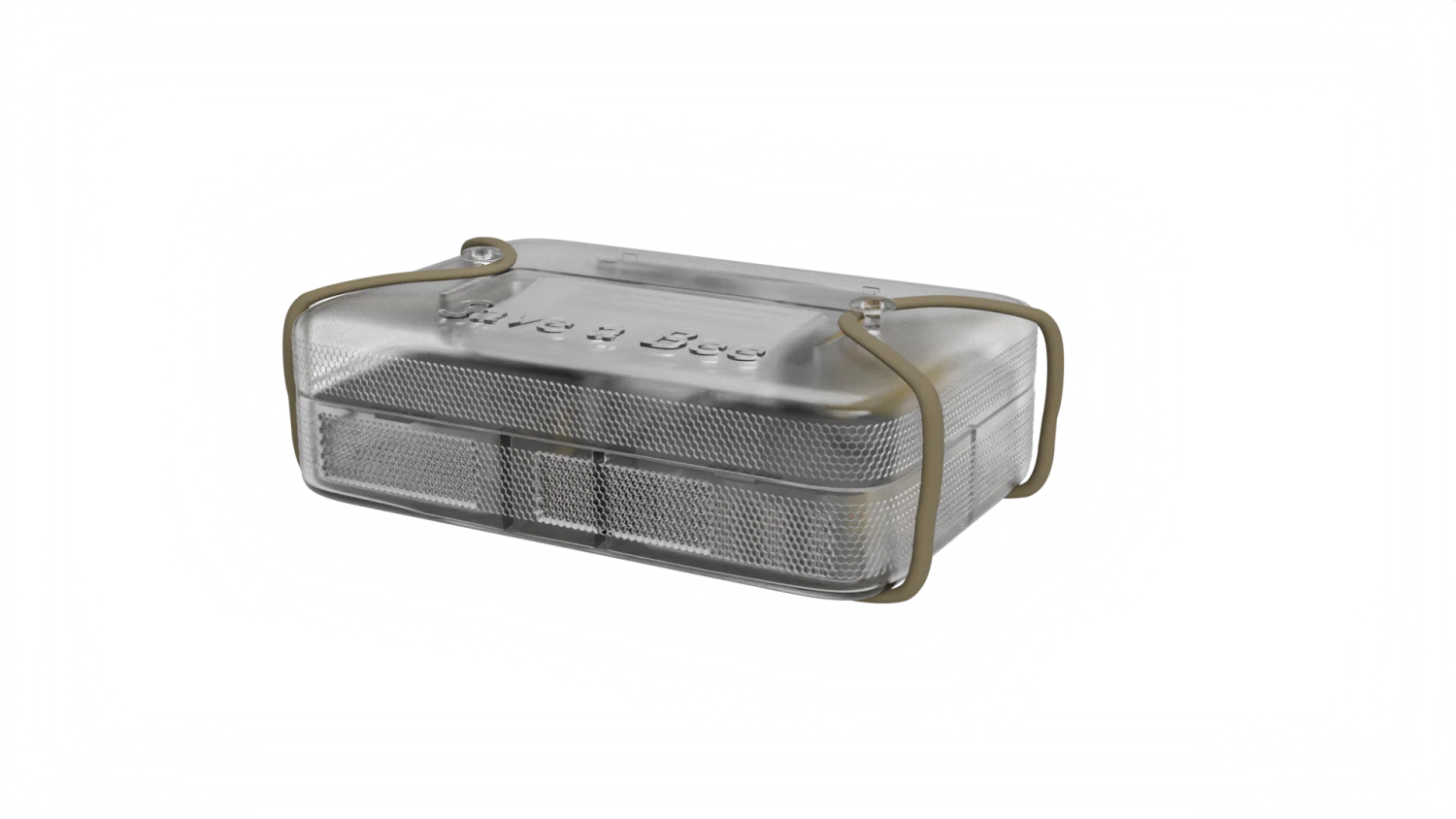
Concept render — no kit has been manufactured yet
A shell designed for recycled ocean-bound plastic.
The shell is designed to be moulded from recycled ocean-bound plastic — waste collected inland, near coastlines, before it reaches the sea; not plastic recovered from the ocean itself. We're qualifying suppliers now, and we'll publish the supplier's name, the certification scheme it's certified to and the exact recycled-content percentage before production begins. We won't state a recycled-content figure until a supplier confirms one. The rest of the kit isn't recycled plastic and we won't imply it is: the dropper is glass, the tweezers steel, the catch-cage clear acrylic, the sponges foam and the guide paper. What we can say is that a kit built to be washed and refilled is one that doesn't get replaced.
What “ocean-bound” means
Waste plastic collected on land near coastlines, before it can wash out to sea — not plastic dredged from the ocean. It's an unregulated marketing term, so here's ours in full: no supplier is contracted yet, no certification scheme is named yet, and no recycled-content percentage is confirmed yet.
Honeycomb everywhere
A subtle hexagon emboss across every face, with real hex vents up front for airflow.
Olive-tan latch straps
Bottom-anchored elastic straps stretch up and over to latch the lid — no loose loops, no clutter.
Wash, refill, reuse
Shell, pods, dropper, catcher and tweezers all wash in hot soapy water; the printed guide in the lid stays dry. The feeding sponge is reusable too — wash it after every rescue, and make that wash a hard rolling boil for a full fifteen minutes: a cold rinse or plain soapy water leaves the durable spores alive, while a boil clears the gut-parasite spores and the wing virus. (Nothing at home reliably kills foulbrood spores — exactly why we say never feed honey.) Four sponges ship, refills are ordinary household sponge, and a clean one costs pennies. The hard parts want two steps: wash the pod, well and catch-cage to lift the syrup, then soak in dilute household bleach — one part to four of water, thirty minutes — and rinse well. Don't boil the clear cage; the acrylic can warp.
Part of every kit funds more bees.
Reviving one tired forager is a small act of joy — she lifts off, and you watch her go. Save a Bee makes that moment count for more. A share of every pledge goes to the mission: planting wildflower forage — the habitat wild bees can't live without — and a separate share paid to working beekeepers. Those two things are different in kind and we won't blur them: the forage is a donation, the beekeeper share is us buying from businesses, not giving to charity. Every kit out in the world is also one more person noticing how much we owe them.
A share of every pledge — declared to Kickstarter up front — goes to the mission: wildflower habitat first, beekeeper support second. The beekeeper share is a purchase rather than a donation. Our partners aren't named yet; we'll name them and publish the split during the campaign, and once kits ship we publish what we sent, and to whom.
A share of every pledge → more flowers, more forage.
Flowers feed every pollinator, managed and wild. A share of every kit plants wildflower forage where it has disappeared; for the bumblebees and solitary bees no one keeps, it's the support that matters most — which is why the conservation money goes to flowers rather than to hives.
The beekeeper share is a commercial partnership with working beekeepers — buying from them and helping cover the real cost of keeping colonies healthy. We won't dress that up as charity. Our partners are being finalised and aren't named yet; we'll name them publicly during the campaign, before it closes, so you can decide with the names in front of you.
We're not going to tell you that funding apiaries is conservation. The honeybee is a managed, farmed animal, and adding hives to a landscape with no flowers in it increases competition and disease pressure on the wild bees already living there. That's exactly why the conservation money buys forage, not colonies.
The kind of present people remember.
Stuck for the nature lover, gardener or curious kid in your life? Save a Bee is thoughtful, beautiful and does real good — a small act of kindness they can hold in their hands.
Meaningful, not more clutter. A present with a purpose — for the person who has everything. Once the kits are made, it gives them a calm, careful way to help a bee that's simply run out of fuel — shade, a safe sip, and back to the sky — instead of one more thing for a shelf.
Made for nature lovers & kids. Made for gardeners, eco-minded friends and curious families. The adult handles the bee; children 8 and up watch, time the rescue and do the release — never for anyone with a known bee or wasp sting allergy. It turns "I want to help bees" into something you can do together.
Beautiful out of the box. A frosted, honeycomb-embossed shell designed to feel like a keepsake, not a gadget — made to be handed straight over, no wrapping needed. (Concept render; kits are made after the campaign funds.)
A story they'll share. Every rescue is a small, shareable moment — the kind of gift people talk about, and think of you each time they lift a bee back into the air.
A gentle rescue is a safe rescue.
Watch her for a moment before you act — then a few calm habits keep both you and the bee safe.
First, check it isn't a wasp
Grounded wasps are common in late summer, they're far more likely to sting than a tired bee, and they don't need rescuing. The quick tells: wasps are smooth and bright yellow with a narrow waist; bumblebees are furry and round; honeybees are amber-brown and fuzzy. If it's a wasp, leave it — and don't leave an open, syrup-scented pod unattended while you work out which one you've got.
A big spring bumblebee is probably a queen — leave her
A large, slow bumblebee in early spring, or one found indoors in autumn or winter, is very likely a queen, and a queen is a whole colony that hasn't happened yet. Don't warm her and don't keep her: warming a bee in torpor raises her metabolism and burns exactly the reserves she's conserving, and a spring queen moved away from her nest may never get back to the eggs in it. Leave her where she is. Only if she can't stay there — indoors, or somewhere she'll be trodden on — move her gently, the shortest way, to a cool, dry, sheltered spot outdoors: under a hedge, in a log pile, out of the wind. Then leave her alone. She would physically fit in the catch-cage, but fit isn't the point: she's the one bee we ask you never to use it on. If she does have to be moved, let her walk onto a leaf and carry her that way — never the cage. She would physically fit in the catch-cage, but fit isn't the point: she's the one bee we ask you never to use it on. Move her gently on a leaf instead.
Look at her wings before you reach for the cage
Wings that are crumpled, shrivelled, stubby or twisted mean she can't fly, and bee-water won't change that. On an otherwise fresh-looking honeybee that's usually deformed wing virus, carried by varroa mites — which means a colony somewhere close by. Ordinary wear is different: an older forager with small nicks and frayed edges flies perfectly well, so treat her like any other grounded bee. If the wings are deformed, don't cage her and don't pod her. Let her walk onto a leaf and set her down in cover — a hedge bottom, a border, anywhere off the path and out of the sun. If you keep finding bees like her in one spot, tell a local beekeeping association: it points to a colony that needs help.
A bee in water — lift her out on something flat
Pools, birdbaths, water butts and half-finished drinks catch a lot of bees, and the catch-cage is no use in water. Slide a leaf, a card or anything flat under her and lift her out — still no fingers. Set her down out of the wind on a dry, sheltered surface, out of direct sun, and let her groom herself dry. Don't rub her with cloth or tissue, and don't offer bee-water to a soaked bee: syrup on wet hairs mats them, and drying comes first. Once she's dry and walking steadily, give her the usual short watch — if she still doesn't fly, then she's out of fuel.
Let the bee come to you — never bare hands
Don't lift a bee with your fingers — catch her with the catch-cage, or let her walk onto a leaf or card, and guide her into a pod. That protects you from stings and the bee from being crushed (squashing is the main cause of stings). Only ever help a genuinely grounded bee; never chase a healthy one.
Not for anyone allergic to stings
This kit brings you close to live bees, so it isn't for anyone with a known bee or wasp sting allergy. Watch for serious reactions — swelling of the face or throat, trouble breathing, faintness — and call emergency services straight away if any appear.
White sugar water only — never honey
Bee-water is just plain white granulated sugar and water, offered as 4–5 drops on the pod's well sponge — never poured onto the bee herself, where it mats her hairs and can block the spiracles she breathes through. Never feed honey: shop honey can carry foulbrood spores, and a bee who drinks it can carry them home into a hive. Not brown sugar, and not powdered/icing sugar — its anti-caking starch upsets a bee's digestion. Don't flood the sponge or force the bee to drink.
Never feed near a hive, and never leave syrup out
Open sugar syrup near a colony starts robbing, which can kill a hive, and it recruits wasps that will kill the bee you're trying to help. Don't work a bee within sight of a hive entrance, don't leave a pod open and unattended, and never set bee-water out as a feeding station.
Mix fresh, wash after every rescue
Mixed bee-water keeps about a day in a warm bag — sugar syrup ferments and moulds fast, and fermented syrup is bad for bees, so tip out what's left and rinse the bottle after every rescue; the bottle ships empty for the same reason. The kit washes clean too. After each rescue, boil the feeding sponge hard for fifteen minutes — a quick rinse leaves bee pathogens alive, and four sponges ship so a clean one is always ready. Wash the pod, well and catch-cage, then soak them in dilute bleach. And never carry two bees from different places in the same kit.
Brief stay, then release where you found her
Move her out of harm's way and into the pod — 4–5 drops of bee-water on the well sponge, never poured onto the bee herself. This is short-term first aid, not a home: once she's up and moving, release her where you found her, or as close as is safe. She was already on her way somewhere, and a forager who gets carried off has to find her colony all over again. Keep the carrying to minutes, and don't take her home.
A grown-up's hands near the bee
Treat this as a supervised activity, not a toy. We recommend ages 8 and up, always with an adult — and an adult should decide whether a bee truly needs help and handle anything close to it.
Wash up, keep small parts from little ones
The kit contains small parts — keep it away from children under 3. After every rescue, wash your hands and any tool you used: good hygiene after handling wildlife, and it clears scent that could agitate other bees.
Everything you might be wondering.
Because most of the time she is. Honeybee foragers — the workers who leave the nest to gather nectar and pollen — are all female, and gathering for the nest is female work in bumblebees and solitary bees too. But males are out there as well: male bumblebees leave the nest for good and live entirely on flowers, which is exactly why you find them grounded in late summer. So sometimes it will be a him. We say “she” because it's true most of the time, and because a tired somebody is easier to care about than a tired something.
One more forager, back in the air.
Kits from $39 at launch — the launch list gets the link first.
Be first when we go live.
Leave your email — your free Bee Rescue Field Guide opens right away, and the launch-day link comes to you first. The Early Bee price is capped at 200 kits, and the list hears first.